
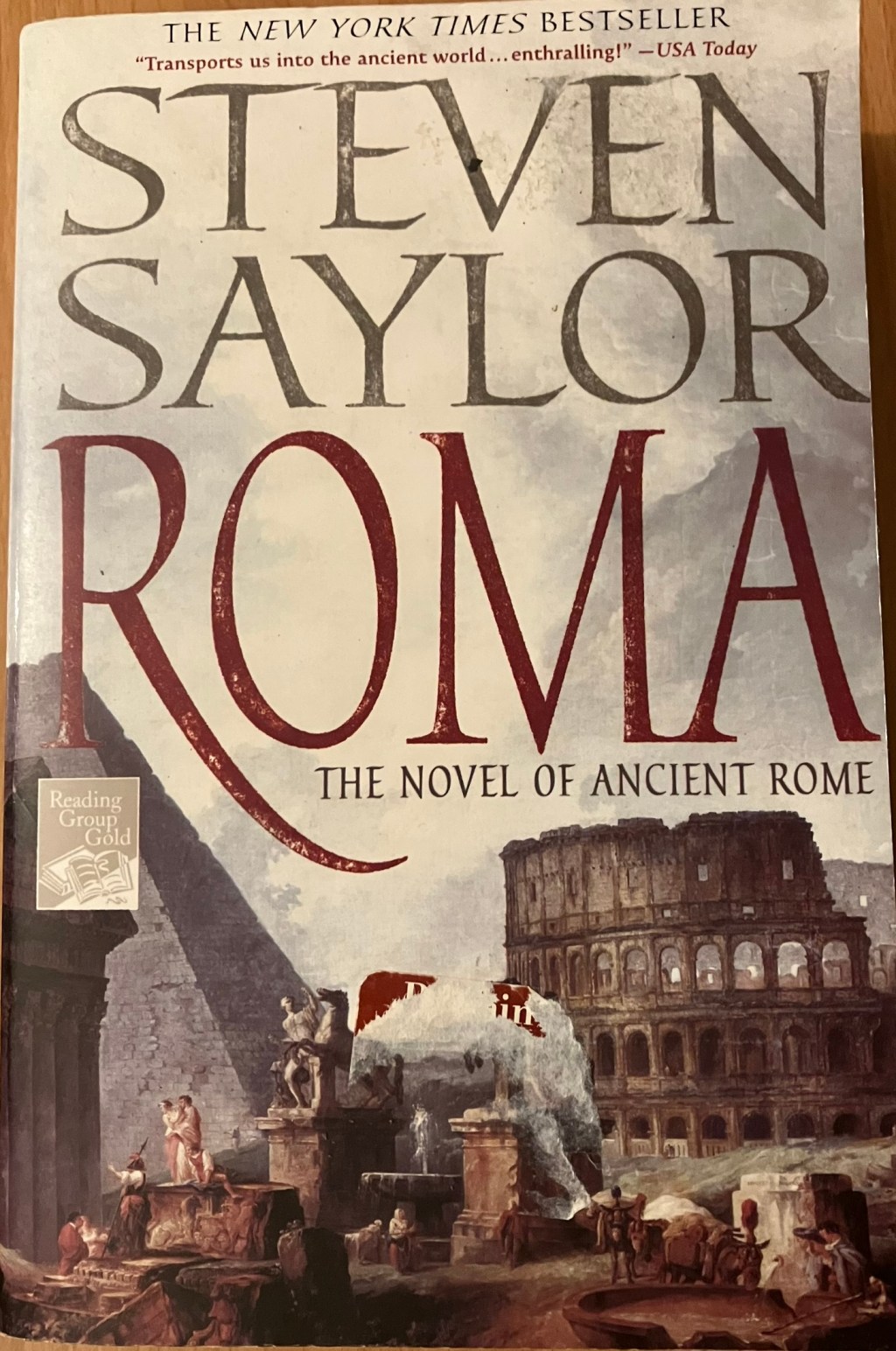
Steven Saylor’s Roma has been sitting on my shelf for a while now and I was excited to finally read it. I had heard a lot of good things about the book. Sadly, it did not live up to my expectations.
I knew what I was getting into. It is a daunting task for any author to try and cover thousands of years of Roman history in one book. I was hoping for the best.
The good part is the author’s knowledge of the subject. Throughout the writing, the reader learns a great deal of history, delving into the traditions and establishment of various myths, rituals and cults that became firmly etched into the labyrinth of Roman society. The way the author weaved them into some of the stories gave the tales interesting depth.
The bad part is the number of stories featuring paper-thin characters who often had one trait, behavior or flaw to separate them from everyone else.
You start in the year 1000BC when the land where Rome would one day stand is just fertile fields, woods and streams. A simple peaceful superstitious band of salt traders comes into contact with another band of wanderers and following the mythical signs they heed, the story begins.
Climbing forward in time, jumping years, sometimes decades and generations, always focused on the descendants of these early tribal people and their interactions with one another and the progress of society, the building of architecture, an economy and politics.
It was curious how some descendant would suddenly for no reason necessary to the current story, begin explaining to someone else in the story the history of things we already know as readers. This slowed the book down every time it happened.
And the characters never really grab the reader. Not me anyhow. The stories weren’t particularly gripping and nothing grabs at your heartstrings or pulls you deeper. You’re just skimming along the surface of a more compelling tale. Characters move moment from moment and in the back of your head you’re just waiting for these people and their generation to die off so you can proceed to the next. It was a weird way to feel while reading a book. ‘I sure can’t wait until they are dead and see what their kids or grandkids do.’
The book wasn’t difficult to read, yet I still found it hard to turn the page at times, not wanting necessarily to finish the book. But I started it, so I felt obligated to get to the end.
This style of storytelling might work for some, but it didn’t work for me. The historical, traditional and mythological aspects are first rate, and for that reason I’m giving it three stars.
Allen M Werner is the author of the epic fantasy series
THE CRYSTAL CRUX
 Author Allen M Werner
I’d like your feedback