

My devil had been longed caged; he came out roaring. I was conscious, even when I took the draught, of a more unbridled, a more furious propensity to ill.
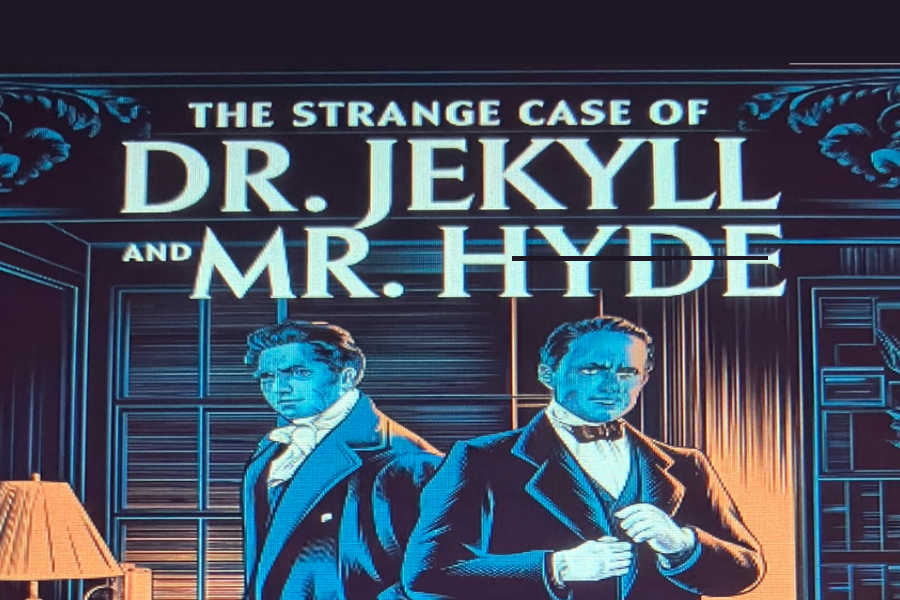
The Strange Case of Dr Jekyll & Mr Hyde by Robert Louis Stevenson is an uneventful philosophical exploration of mankind’s eternal struggle with respectability and lawfulness against impulses and wickedness, or as some might say, the duality of human nature.
Spoiler Alert:
I cover the entire story in this review
I knew myself, at the first breath of this new life, to be more wicked, tenfold more wicked, sold a slave to my original evil; and the thought, in that moment, braced and delighted me like wine.
While this exploration of duality may have been a curious and taboo subject to Victorian age readers, it has been written many times since in various forms. This original telling doesn’t quite hold up to the scrutiny of our recent history, factually and fictionally. We’ve sadly seen this human struggle played out in real life as often as in fiction with far more haunting and heartbreaking consequences, violence and bloodshed.
In short, it’s not new to us as readers today so I think it’s important when we do read it, to look at it through the lens of people reading it in those days.
Mr Hyde broke out of all bounds and clubbed him to the earth. And next moment, with ape-like fury, he was trampling his victim underfoot and hailing down a storm of blows, under which the bones were audibly shattered, and the body jumped upon the roadway. At the horror of these sights and sounds, the maid fainted.
The story is primarily told from the viewpoint of Dr Jekyll’s lawyer, Mr Utterson.
Utterson has been entrusted with Dr Henry Jekyll’s will and is concerned that the only beneficiary to his estate is a loathsome, elusive man named Edward Hyde.
The book reads that “this document had long been the lawyer’s eyesore.”
Utterson fears that Jekyll is somehow being coerced to make this will by Mr Hyde. Utterson sets off to investigate this situation and learn more about this strange Mr Hyde whom he crosses paths with once and immediately takes a dislike to. Although they have never met, Mr Hyde knows him, which was offputting.
Mr Hyde was pale and dwarfish, he gave an impression of deformity without any nameable malformation, he had a displeasing smile, he had borne himself to the lawyer with a sort of murderous mixture of timidity and boldness, and he spoke with a husky, whispering and somewhat broken voice; all of these points against him, but not all these together could explain the hitherto disgust, loathing, and fear with which Mr Utterson regarded him.
Things take a turn when a maid witnesses Mr Hyde murdering a member of Parliament.
Mr Hyde proceeds to go into hiding for a spell and things calm for a bit.
That is until Jekyll’s manservant Poole begs Mr Utterson to help him break into Jekyll’s laboratory after hearing strange sounds on the other side of the door.
Mr Utterson, fearing that Mr Hyde may try to kill Dr Jekyll, agrees to break in with Poole.
Right in the midst there lay a body of a man sorely contorted and still twitching. They drew near on tiptoe, turned it on its back and beheld the face of Edward Hyde.
They search in vain for Dr Jekyll, and wonder if he fled.
Probing the laboratory, they discover a series of letters that reveal the truth of the matter. The story ends with a posthumous letter written by Jekyll himself revealing his dangerous experiments, his use of drugs, and the eventual takeover of his body by Mr Hyde.
Dr Jekyll murders himself to stop Mr Hyde from hurting anyone else.
The reader is given no further insight into how Mr Utterson or the legal system dealt with the fallout of the letter and body, and missing Dr Jekyll.
The writing here is uncommon to the present-day reader. I had to read it slowly in places to take in the fullness of the author’s words. Most often, I found it the way it was written more interesting than difficult.
You must suffer me to go my own dark way. I have brought on myself a punishment and a danger that I cannot name. If I am the chief of sinners, I am the chief of sufferers also.
It’s an old tale but I think it’s worth a read.
While there is no real action or horror, the conflict between good and evil in humans is always a chilling subject.
The tale is an external examination of a troubled character followed by his own personal testimony through a lengthy letter to his survivors.
I’m glad I read it, but I’ll probably never read it again.
3 stars.



I’d like your feedback