
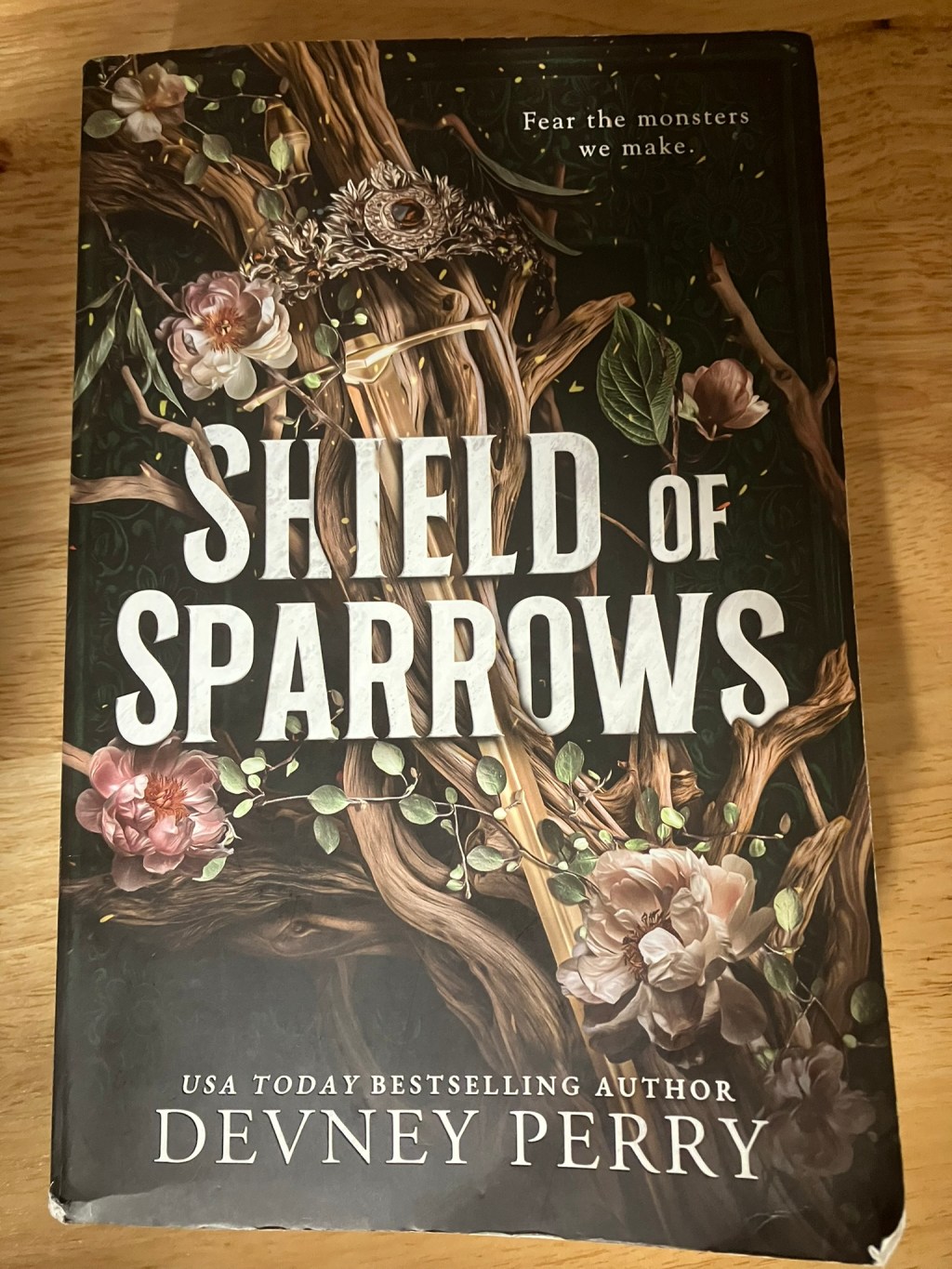
Here’s my review of Shield of Sparrows by author Devney Perry, the first book in the Shield of Sparrows series.
I will start by saying this might be one of the most frustrating books I’ve read in a long time. The author did a great job creating an interesting world full of rangers and monsters, magic and secrets, kings and oaths. I really wanted to give this book 5 stars. The story, especially near the end, is good.
I’m giving it 4 stars, however, because there are portions and elements of the book I hated. And I mean hated. Most of these portions and elements were in the first half of the book.
The reader of Shield of Sparrows lives inside Odessa Cross’ head. Inside Odessa Wolfe’s head. There are no other viewpoints. Everything you learn about this world is either how Odessa understands it or how it is revealed to her.
If someone ever tells you that successful authors need to show not tell, hand them this book and say, No, they don’t. There’s a lot of telling in Shield of Sparrows and I personally have no problem with that. I think show don’t tell is something created by people who want to hold storytelling to some imagined higher ideal that doesn’t exist.
But good storytelling is good storytelling, and there is some good storytelling in this book.
One of the biggest problems I had with the Shield of Sparrows, however, was the objectification Odessa has for the Guardian. At times, her objectification of the Guardian becomes too much of the story. There are way too many lines devoted to her objectification.
And probably worse, Odessa couldn’t stop overthinking everything. She questions every look, every word, every nod, every cough. People can’t even have a simple conversation without the author letting Odessa ramble on in her head, overthinking the nuances of what was said and how it was said.
In my opinion, it slowed the story down and made the larger story secondary to her petulant whiny thought process. And she could be quite petulant and whiny. Every character that didn’t agree with her was loathed and despised by her. She expected everyone to agree with her and go along with her thinking, even when she apparently didn’t know anything about anything. She was quite sheltered.
In one scene, Odessa is nearly killed by a monster, and moments after she is saved from this terrifying situation, her first response to her savior is sheer disrespect and arrogance. She doesn’t display a shred of humility. That didn’t feel real at all, even for a fantasy character.
Another weakness I must point out is that Odessa had no friends. None. Her two lady maids, Brielle and Jocelyn, were the closest things to friends she had. It was as if she had no friendly acquaintances either. No one. Just people in the palace she chose to ignore and avoid.
Excerpt – “When I was younger, I’d had a flock of friends, mostly daughters of wealthy noblemen in the city. The girls would come to the castle for tea, and we’d play with dolls. As we grew, we would attend balls and parties together. And then they’d gossip about me behind my back. They faked our friendships so they could glean information about my father to relay back to theirs. Or they faked our friendships because they thought it would improve their station. I hated fakes. I hated lies. So I’d stopped making “friends.”
Everyone was against her? Everyone is fake? Everyone was a liar? Everyone was using her? There wasn’t one young single lady near her age who actually liked her and wanted to be friends for the sake of being friends? Everyone?
Excerpt – “So I dwelled. On. Everything. My own mind had become my worst enemy. There wasn’t a single safe topic. I dwelled on my family. I dwelled on Brielle and Jocelyn and how they would undoubtedly hate me when this was over. I dwelled on Zavier and his disinterest. I dwelled on the gods and how they seemed to both love and hate humans. I dwelled on the stench on my breath and the stink of my body. I dwelled on the point of my chin and the taper of my nose. And no matter how hard I tried to stop it, I dwelled on the Guardian.”
Excerpt – “Maybe I should have given myself time to think about everything he said. But gods, I was tired of thinking and overthinking and doubting and dwelling.”
Stop! We are tired of it too. Stop letting us in on every ridiculous thought that passes through Odessa’s head.
I think, if the author had removed much of this overthinking and objectification, the book would have been a great deal shorter and far more impactful.
Excerpt – “A bariwolf emerged from beside the corner of the tavern. All it had to do was turn, and it would see us pressed against the locked door. It was five feet away, the fur on the back of its neck raised. It was either the largest in the pack or it was just the closest, because the goddamn creature was enormous. My breath lodged in my throat. I refused to blink. I stared at it while its focus was solely locked on the Guardian, still fighting. Only now he had more monsters to slay. How? He couldn’t fight nine monsters alone.”
I’ve read some romance fantasy over the years and I never cared for it. I’m guessing this kind of overthinking and objectification is what the author’s audience has come to expect from her. This is what her readers want. Overthinking. Dwelling. Assuming. Doubting. Objectifying.
For three quarters of the book, Shield of Sparrows could have been considered a YA book. It is an easy book to read. It’s not an overcomplicated fantasy story. It contains several twists, some expected, some not. There were a few curses along the way but no adult situations or graphic violence until way late in the book. A very slow burn indeed, which was ok with me.
Now, don’t get my criticism wrong. I really liked the Shield of Sparrows, especially the last third but I can’t ignore the loathing I had for Odessa’s constant questioning, dwelling and objectification from the beginning.
The introspectiveness seemed milder later in the book, as was the objectifying, but certain secrets had been brought to life making those a bit less necessary, even though she was still overly stubborn at times.
I think anyone who loves fantasy fiction will enjoy reading this book, and maybe they can overlook Odessa’s objectification and overthinking better than I.
The end of the book is worth all the rest of dialogue and exchanges along the way.
A good payoff.
There is a second book in the series called Rites of the Starling which I will read in the future.
4 stars.
Allen M Werner is the author of the dark fantasy tale The Crystal Crux Series and Ares in Chains, the first in the Shades of Myth series.






 Author Allen M Werner
I’d like your feedback